


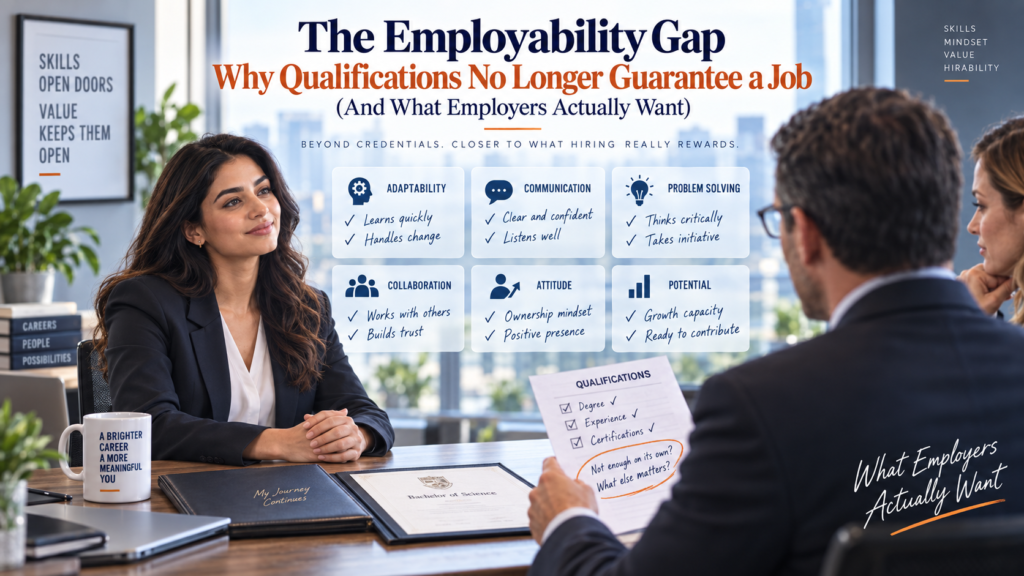
A decade ago, a relevant degree was close to a guaranteed ticket into a stable career. Today, graduates with strong academic records are sending out hundreds of applications and hearing nothing back. This is the employability gap the widening distance between what education certifies and what employers are actually hiring for. It isn’t that qualifications stopped mattering. It’s that they stopped being sufficient on their own.
If you’re qualified on paper and still struggling to get hired, you’re experiencing this gap directly, not doing anything wrong. Below, we break down exactly why the employability gap has grown so wide, what employers say they actually want when they can’t find it, and the practical, structured path including the kind of job ready training built specifically for this problem to closing it.
What Is the Employability Gap, and Why Is It Growing?
The employability gap is the difference between the skills a qualification certifies and the skills a role actually requires on day one. It exists because education and industry move at different speeds: a curriculum is designed years in advance, while the tools, platforms, and expectations of a modern workplace shift continuously.
The gap has widened further because technology roles in particular now demand practical, hands-on proficiency that traditional coursework was never built to deliver at scale. A candidate can graduate with excellent grades and still have never worked with the specific tools, workflows, or real-world constraints their target employer expects from day one.
Why the Employability Gap Keeps Qualified People Unemployed
None of the reasons below reflect a lack of intelligence or effort. They reflect a structural mismatch between how education is delivered and how hiring decisions actually get made.
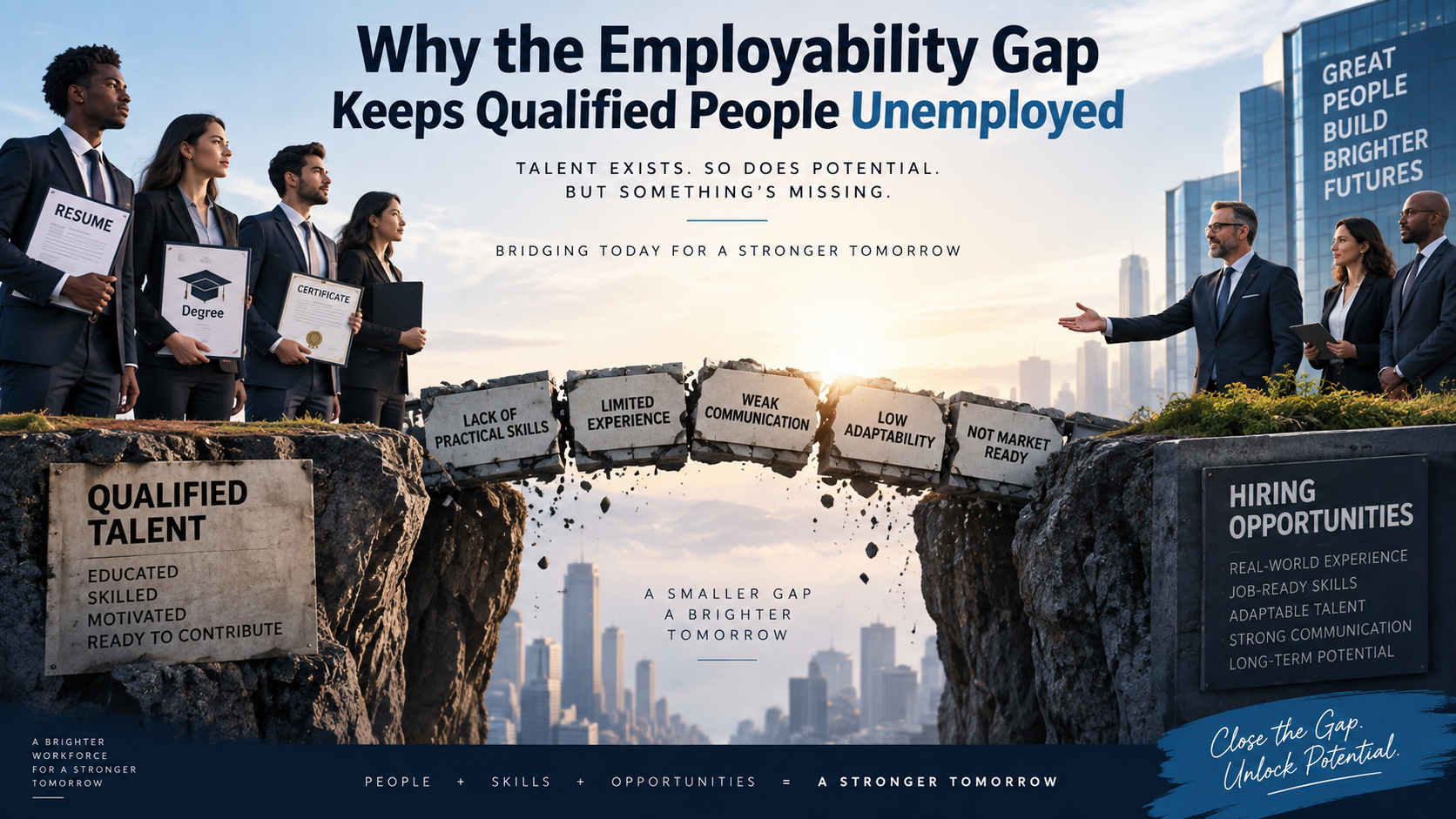
1. Theory without applied, hands-on practice
Understanding a concept in a lecture is different from applying it under real workplace constraints. Employers increasingly test for the second, not the first and candidates whose only exposure was theoretical routinely underperform in practical assessments relative to their academic record.
2. Outdated tools and platforms taught in the curriculum
Formal courses can lag years behind the tools currently used in industry. A graduate trained on an outdated platform arrives needing significant on-the-job retraining, which employers are increasingly unwilling to absorb for roles that used to be considered entry level.
3. No portfolio of real, demonstrable projects
A transcript lists subjects passed. It doesn’t show a hiring manager what a candidate has actually built, solved, or delivered. Without a portfolio of real projects, qualified candidates are asking employers to take their competence on faith.
4. Missing soft skills that were never formally taught
Communication, stakeholder management, and workplace collaboration are rarely graded in a degree program, yet they’re consistently cited by employers as deciding factors between two similarly qualified candidates.
5. No local work experience or industry context
For migrants and international graduates especially, a lack of local work experience or understanding of local workplace norms can outweigh strong technical qualifications in a hiring manager’s decision, even when the underlying skill is genuinely there.
6. A certification that isn’t matched to current market demand
Not every certification carries equal weight, and some qualifications simply aren’t what employers in a given field are currently screening for. Workforce data published by Jobs and Skills Australia shows demand shifting quickly across sectors, and a mismatch between what you’re certified in and what the local job market currently needs widens the employability gap further, no matter how hard-earned the credential was.
What Employers Actually Want Instead
When employers are asked directly what would make hiring easier, the same themes come up again and again:
- Demonstrable, hands-on skill with the current tools and platforms the role actually uses.
- A visible portfolio of real projects, not just a list of completed subjects.
- Strong communication and workplace collaboration skills, not just technical competence.
- Certifications that map directly to current, in-demand market needs.
- Evidence of local work experience or context, particularly for roles involving stakeholders or clients.
None of this requires abandoning a formal qualification it requires layering practical, current, job-ready training on top of it, which is exactly the gap structured job ready programs are designed to close.
How to Close the Employability Gap
Closing the gap isn’t about getting a second degree. It’s a deliberate, structured sequence that most self-directed job seekers never have access to on their own.
Step 1: Add hands-on, project-based training to your qualification
A structured Job Ready Program layered on top of your existing qualification gives you practical, current experience with the tools employers actually use closing the theory-to-practice gap directly.
Step 2: Build a portfolio you can show, not just describe
Document real projects even self-directed ones with clear explanations of the problem, your approach, and the outcome. This portfolio becomes tangible evidence a resume alone can’t provide.
Step 3: Choose certifications aligned with current market demand
Research which certifications employers in your target field are currently asking for, rather than defaulting to the most familiar or most advertised option. Cross-checking against current labour-market data from Jobs and Skills Australia can help confirm relevance before you invest time and money. Current relevance matters more than prestige alone.
Step 4: Develop the soft skills employers rate as deciding factors
Seek out structured practice in communication, stakeholder handling, and workplace collaboration through group projects, mock scenarios, or coached practice since these are rarely part of formal academic assessment.
Step 5: Get local work experience or a structured internship
Local, hands-on work experience even short-term or project-based closes the context gap that pure qualifications can’t address, and it gives you concrete, locally-relevant examples for interviews.
Step 6: Get career coaching to translate your skills for employers
Resume building, interview preparation, and structured career counselling help translate what you already know into the language and format employers are actually screening for often the single fastest lever available.
The Employability Gap and Job Ready Training Across Australia
The employability gap shows up consistently across Australia’s major job markets, but so does the fix. Structured Job Ready Programs combining hands-on IT training, recognised certifications, local work experience, and career counselling are available in Sydney, Melbourne, Brisbane, Perth, Adelaide, and Canberra, giving graduates, migrants, and career changers a structured way to close the gap rather than closing it through trial and error.
The pattern holds across every one of these cities: candidates who pair their formal qualification with structured, practical training and local work experience are consistently more competitive for entry-level and mid-level roles than those relying on the qualification alone.
Choosing the Right Job Ready Program to Close the Gap
Since the employability gap is fundamentally a practical-experience gap, program choice matters. Look for a program that offers:
- Hands-on, project-based learning aligned with current industry tools and workflows.
- Certifications that map to current market demand, not outdated standards.
- Local work experience or internship components, particularly valuable for migrants and career changers.
- Dedicated career counselling: resume, cover letter, and interview preparation support.
- Flexible formats full-time, part-time, or live online that fit around existing commitments.
The Job Ready Program is built around exactly this combination practical IT training, recognised certifications, local work experience, and structured career support designed specifically to close the employability gap rather than add another credential to the pile.
Frequently Asked Questions
What exactly is the employability gap?
The employability gap is the difference between the skills a formal qualification certifies and the practical, current skills employers actually require to be productive from day one in a role.
Why don’t qualifications guarantee a job anymore?
Qualifications certify foundational knowledge, but employers increasingly hire based on demonstrable, hands-on skill, a visible portfolio, and workplace-ready soft skills none of which a transcript alone proves.
How does a job ready program help close the employability gap?
A structured job ready program adds the missing layer on top of a formal qualification: hands-on practical training, current certifications, real work experience, and career coaching, all aimed directly at what employers say they’re missing in applicants.
Is a job ready program worth it for migrants and career changers specifically?
Yes, often more so. Local work experience and context are frequently the biggest employability gap for migrants and career changers, and structured programs are specifically designed to provide that missing local, practical experience.
Final Thoughts
The employability gap isn’t a reflection of how capable or qualified you are. It’s a reflection of a mismatch between what education certifies and what a fast-moving job market actually demands. Closing it doesn’t mean starting over it means layering practical, current, demonstrable experience on top of the qualification you already have.
If you’re ready to close that gap the right way, explore the Job Ready Program and take the first step toward becoming the candidate Australian employers are actually looking for.