




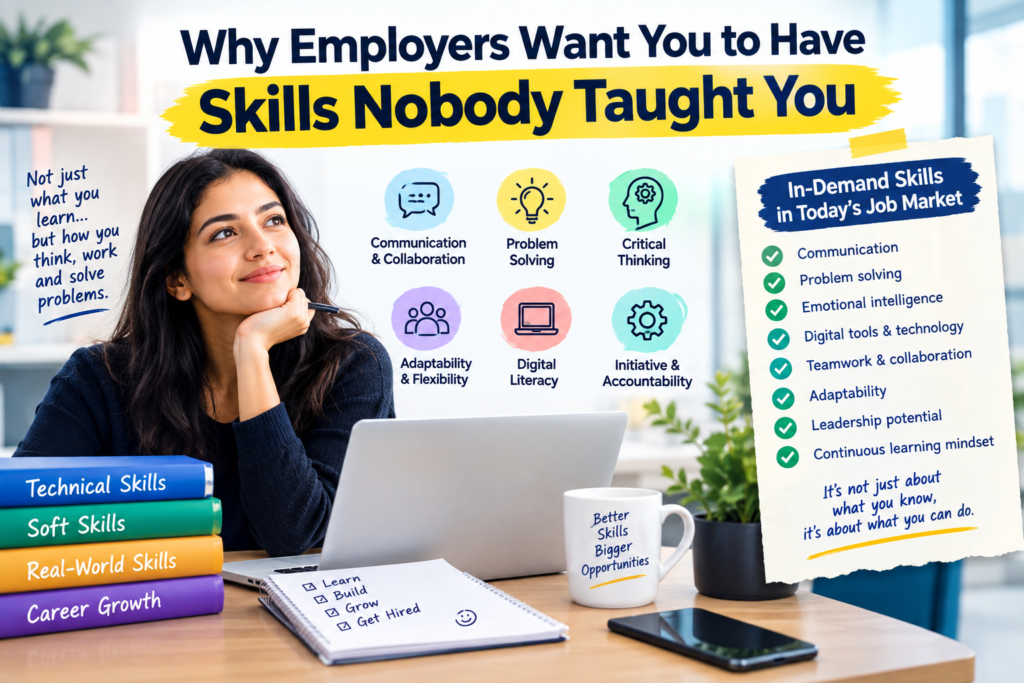
Skills nobody taught you in school are, ironically, the skills employers now care about most. You can graduate with excellent grades, a strong transcript and every box ticked, and still lose a job to someone with a thinner resume but sharper instincts. That’s not unfair hiring. It’s a sign that the workplace runs on a curriculum nobody handed you a textbook for.
Classrooms are built to test what you know. Workplaces run on what you do with it, how you communicate under pressure, how you recover from a mistake, and how quickly you pick up a tool nobody trained you on. These are the skills nobody taught you formally, yet they now decide who gets hired, promoted and trusted with bigger responsibility.
Why Employers Want Skills Nobody Taught You More Than a Perfect Transcript
Employers are not undervaluing education. They are simply being honest about what a degree can and cannot prove. A transcript shows you can learn and retain information under exam conditions. It says almost nothing about how you’ll behave in a messy meeting, a tight deadline or a disagreement with a colleague. That gap is exactly why employers want skills nobody taught you as much as, or more than, formal qualifications.
Recent workforce research backs this up directly. A well-known 2025 global jobs report found that a large share of core employability skills are expected to change by 2030, faster than most classrooms can update their curriculum. Separately, most employers surveyed across the UK and Australia say graduates are not fully workplace ready on arrival, with the biggest gaps sitting in communication, resilience and applied problem-solving not technical knowledge.
The Skills Nobody Taught You (But Employers Expect Anyway)
Here are the six skills nobody taught you in a classroom that consistently show up in what employers are looking for in 2026.
1. Reading the Room and Communicating Across Formats
No one grades you on switching tone between a client email, a Slack message and a video call, yet employers expect exactly that. Communicating clearly across formats, and reading what a situation actually calls for, is one of the most in-demand skills nobody taught you directly.
2. AI and Digital Confidence
Using new software, prompting AI tools responsibly and spotting when a tool has gone wrong are now everyday expectations, not IT-department specialities. Almost every non-technical role now assumes a level of digital confidence that most courses never formally teach.
3. Owning a Problem Without Being Told
Initiative, taking action before someone tells you to, is one of the clearest signals employers use to separate strong hires from average ones. It’s rarely marked on any assignment, but it’s one of the skills nobody taught you that gets noticed fastest on the job.
4. Emotional Intelligence Under Pressure
Managing your own reaction in a tense meeting, staying professional under criticism, and understanding a colleague’s perspective before responding are skills that only get built through real experience, not a lecture.
5. Reliability: Showing Up and Meeting Deadlines
It sounds basic, but consistent reliability, turning up prepared, hitting deadlines and following through, remains one of the most consistently valued and least formally taught workplace skills.
6. Learning New Tools on the Fly
Roles change faster than curriculums can keep up. Employers now expect people to pick up a new system, platform or process within days, without a full training manual. This kind of rapid, self-directed learning is squarely one of the skills nobody taught you in a structured way, yet it is one employers rank highest.
How to Learn the Skills Nobody Taught You
The gap between classroom learning and workplace expectation is exactly what the Job Ready Program is built to close. Instead of theory alone, it combines certification-focused training, hands-on projects, career counselling and real workplace scenarios, so the skills nobody taught you in school get built deliberately, before you’re expected to already have them on day one.

Popular pathways that build both the technical and unwritten skills employers are looking for include:
- Business Analysis — stakeholder communication and structured problem-solving
- Cloud Computing — hands-on digital confidence with real platforms
- Cyber Security — applied judgement under real-world pressure
- Data Analysis — translating data into decisions, not just reports
- Project Management — ownership, reliability and leading under deadlines
- IT Job Ready — a broad, workplace-ready technology pathway
Every pathway pairs technical training with career counselling, resume support and interview preparation, so the informal, unwritten skills employers expect are practised, not left to chance.
Job Ready Training Available in Cities Across Australia
The Job Ready Program runs instructor-led and live virtual training in major cities, so you can build the practical and unwritten skills employers want wherever you’re based: Melbourne, Sydney, Brisbane, Perth, Adelaide, and Canberra.
Frequently Asked Questions
What are the skills nobody taught you that employers actually want?
Communication across different formats, digital and AI confidence, initiative, emotional intelligence, reliability and the ability to learn new tools quickly are the skills nobody taught you formally, yet employers rank them above raw technical knowledge.
Why do employers care about skills nobody taught you more than grades?
Grades measure what you can recall under exam conditions. Workplace success depends on how you apply knowledge, communicate and adapt, which is exactly why employers weigh unwritten, real-world skills so heavily.
Can these unwritten skills actually be learned?
Yes. Structured, hands-on training closes this gap far faster than trial and error on the job. Programs like the Job Ready Program are built specifically to teach the applied, workplace-ready skills that traditional education leaves out.
How long does it take to build these skills?
Most learners build noticeable confidence within weeks of hands-on, project-based training, especially when it’s paired with career coaching, interview practice and real feedback rather than theory alone.
Ready to build the skills nobody taught you and start standing out to employers?
Contact the Job Ready Program team and get a training pathway matched to your goals.