

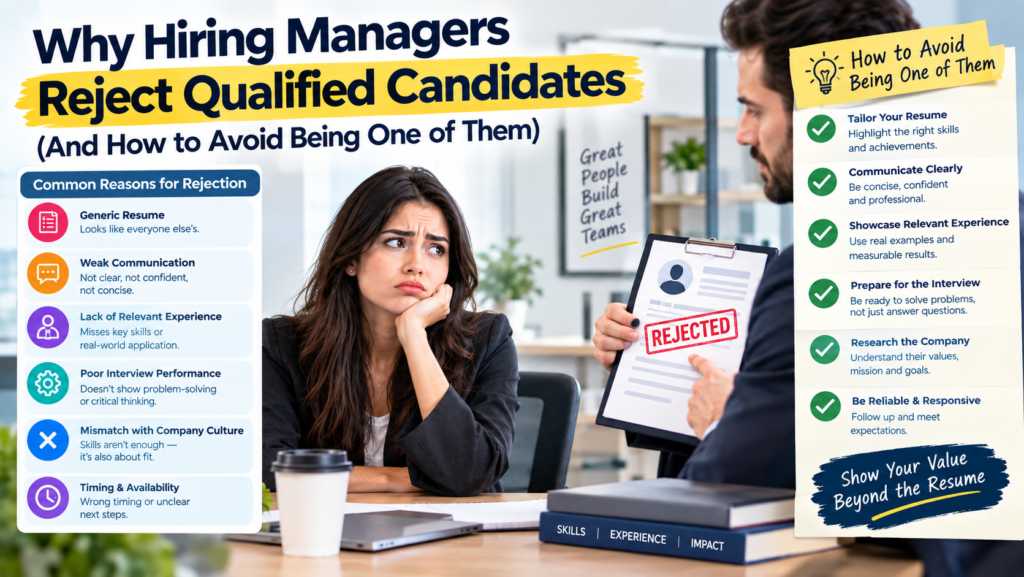


Why hiring managers reject qualified candidates is a question that puzzles a huge number of genuinely capable job seekers across Sydney, Melbourne, Brisbane, Perth, Adelaide and Canberra every year. You have the skills, the certifications, and the resume that got you shortlisted yet the rejection email still comes. The uncomfortable truth is that being qualified on paper only gets a candidate to the interview room. What happens after that is decided by a much smaller, more specific set of factors than most job seekers realise.
This guide breaks down exactly why hiring managers pass on candidates who technically meet every requirement, based on the patterns recruiters and hiring managers consistently describe, and how to avoid making the same mistakes.
Being Qualified Gets You Shortlisted, Not Hired
A resume matching the job description gets a candidate through the first filter automated or human. From that point forward, the hiring manager is evaluating something resumes can’t fully capture: whether this person will actually perform well, work well with the team, and stay engaged in the role. Qualifications answer “can they do it.” The interview answers “will they do it well, here, with us” and that’s where most rejections of technically qualified candidates actually happen.
The Real Reasons Hiring Managers Reject Qualified Candidates
1. They Can’t Explain Their Own Experience Clearly
A candidate whose resume lists strong, relevant experience but who struggles to explain that experience clearly and specifically in the interview raises doubt about whether the resume accurately reflects their actual involvement. Vague, generic answers to “tell me about a project you worked on” are one of the most common reasons a strong-looking resume doesn’t convert to an offer.
2. They Show No Genuine Interest in the Specific Role
Candidates who could clearly be answering questions for any job at any company generic answers, no research into the organisation, no specific reason for wanting this role read as low-commitment hires, regardless of how strong their technical background is. Hiring managers are wary of investing in someone who seems likely to leave the moment a similar offer appears elsewhere.
3. They Can’t Handle a Question They Weren’t Expecting
Interviews that go smoothly through prepared, rehearsed answers but fall apart the moment an unexpected follow-up question arrives signal to a hiring manager that the polish might be memorised rather than genuine understanding. This is especially damaging in technical interviews, where follow-up questions are specifically designed to test real depth.
4. Red Flags Around Team Fit or Attitude
Subtle signals speaking negatively about a previous employer, appearing dismissive of a question, showing impatience with the process often weigh more heavily than hiring managers openly admit. SEEK’s employer hiring guidance consistently emphasises cultural and team fit alongside technical ability, which is exactly why technical skill rarely overrides a genuine concern about how someone will behave under pressure or work within a team.
5. Salary or Availability Expectations Don’t Align
A candidate can be the strongest technical fit and still get passed over because their salary expectations, notice period, or availability don’t align with what the role can actually offer. This is rarely communicated back to the candidate explicitly, which is why it often reads as a confusing, unexplained rejection despite a strong interview.
6. They Don’t Ask Genuine Questions Back
Candidates who have no questions for the interviewer, or only ask questions covered in the job ad, read as passive or under-prepared. Genuine, specific questions signal real engagement with the role and the problems the team is actually trying to solve and its absence is noticed.
Qualified But Rejected vs Qualified and Hired

| Interview Moment | Rejected Candidate | Hired Candidate |
| Describing past experience | Vague, generic summary | Specific, detailed, with a clear outcome |
| “Why this role?” | Generic, could apply anywhere | Specific reason tied to the company/role |
| Unexpected follow-up question | Struggles, falls back on rehearsed lines | Reasons through it, even if imperfectly |
| Discussing a previous employer | Speaks negatively or dismissively | Stays neutral and professional |
| End of interview questions | None, or generic job-ad questions | Specific, thoughtful questions about the role |
How to Avoid Being the Candidate Who Gets Passed Over
- Prepare 3–4 specific, detailed stories about your experience using a clear structure (situation, action, outcome)
- Research the specific company and role enough to give a genuine, non-generic reason for applying
- Practise answering questions you haven’t prepared for by asking a friend to interview you with unscripted follow-ups
- Stay professional and neutral when discussing any previous employer, regardless of how that role actually went
- Prepare 2–3 genuine questions about the team, the problems they’re solving, or how success is measured in the role
Structured interview practice and mock scenarios close this gap fastest, since most of these mistakes only become obvious under real interview pressure. The job-ready training at jobreadyprograms.au is built to include exactly this kind of interview practice alongside technical skill-building, so candidates don’t just become qualified they become genuinely interview-ready.
Frequently Asked Questions
Why do hiring managers reject candidates who meet every job requirement?
Because meeting requirements gets a candidate shortlisted, but hiring decisions are made on interview performance how clearly you explain your experience, genuine interest in the role, and how you handle unexpected questions and team-fit concerns.
How can I tell if I’m making these interview mistakes?
Practising with someone who can ask unscripted follow-up questions is the fastest way to expose vague answers, generic “why this role” responses, and weak preparation before it costs you a real interview.
Is salary expectation really a common reason for rejection?
Yes — it’s one of the least-discussed but most common reasons a strong candidate doesn’t get an offer, and it’s rarely communicated back explicitly, which is why it can feel like an unexplained rejection.
Final Thoughts
Why hiring managers reject qualified candidates comes down to a specific, learnable set of interview and communication gaps not a lack of genuine qualification. Candidates who succeed across Sydney, Melbourne, Brisbane, Perth, Adelaide and Canberra are consistently the ones who prepare specific stories, show genuine interest in the specific role, and handle unexpected questions with composure rather than rehearsed lines.
To close this gap before your next interview, Logitrain offers structured career training, and the jobreadyprograms.au and businessanalystcourse.au microsites cover both the technical and interview-readiness skills employers are actually evaluating.