



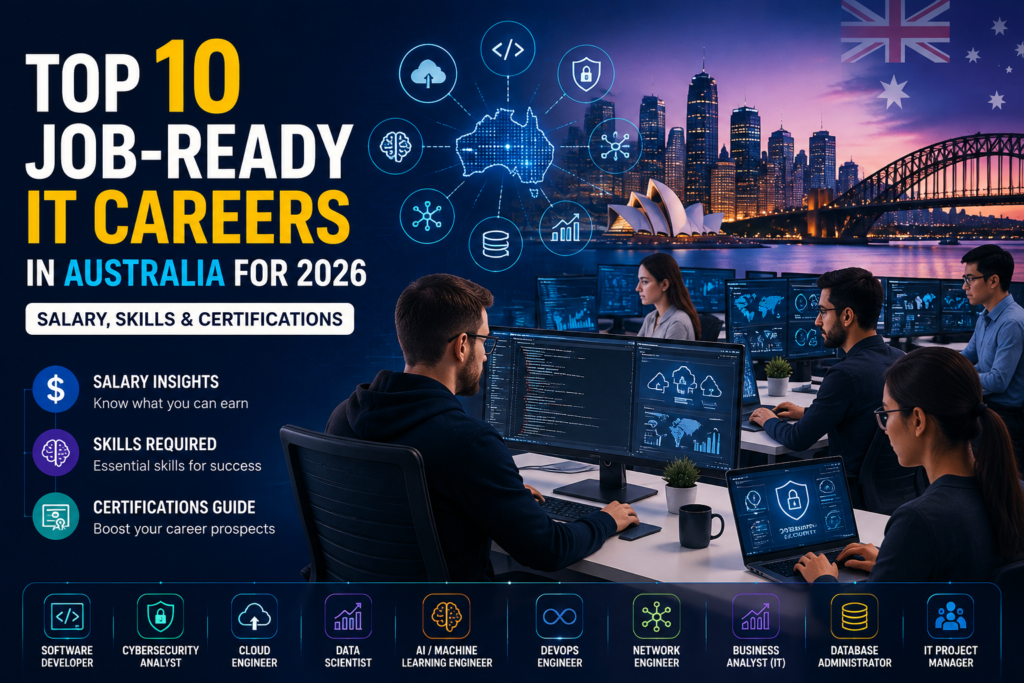
IT careers in Australia are having a genuine moment. Employers across banking, healthcare, government, and retail are all competing for the same small pool of skilled tech talent, and that imbalance keeps pushing salaries up and opening doors for graduates, career changers, and skilled migrants. Whether you’re weighing your first move into tech or planning a switch out of a stalled career, this guide breaks down the ten most job-ready IT careers in Australia for 2026 what each role actually pays, the skills employers are screening for, and the certifications that get your resume shortlisted.
Why IT Careers in Australia Are Booming in 2026
Australia’s technology workforce gap keeps widening rather than closing. The Australian Computer Society projects that demand for ICT professionals could outstrip supply by more than 350,000 workers by 2030, and Jobs and Skills Australia’s occupation shortage reporting continues to list cybersecurity and software engineering among the hardest roles to fill nationally, with forecasts pointing to more than 58,000 new technology positions by 2028. That shortage is exactly why an IT career in Australia is such a reliable bet right now. Employers are hiring faster than universities and bootcamps can graduate people, certifications and demonstrated skills increasingly count for as much as a degree, and most in-demand IT occupations sit on skilled migration lists that support visa sponsorship and permanent residency pathways.

Top 10 Job-Ready IT Careers in Australia for 2026
These are the IT careers in Australia attracting the strongest hiring demand and salary growth this year, ranked by a mix of job volume, pay, and how quickly you can realistically become job-ready in each one.
1. Cyber Security Analyst
Cyberattacks now hit Australian organisations at an alarming rate, and that constant pressure has made cybersecurity one of the most protected IT budget lines in the country. As one of the fastest-growing IT careers in Australia, cyber security analysts monitor networks, investigate incidents, and close vulnerabilities before they become breaches.
- Salary: $100,000–$120,000 (SEEK), rising past $150,000 for senior analysts
- Key skills: SIEM tools, incident response, penetration testing, risk & compliance
- Certifications: CompTIA Security+, CISSP, Certified Ethical Hacker (CEH)
- Get job-ready: Cyber Security course
2. Cloud Engineer / Cloud Architect
As Australian businesses keep shifting infrastructure to AWS, Microsoft Azure, and Google Cloud, cloud engineers who can design, migrate, and secure that infrastructure are some of the hardest hires on the market — and consistently one of the highest-paying IT careers in Australia.
- Salary: $130,000–$150,000 (SEEK)
- Key skills: AWS/Azure architecture, Infrastructure as Code (Terraform), containerisation, networking
- Certifications: AWS Certified Solutions Architect, Microsoft Azure Administrator (AZ-104)
- Get job-ready: Cloud Computing course
3. Data Analyst
Every industry now runs on dashboards and forecasts, and data analysts are the people turning raw numbers into decisions leadership teams actually act on. It’s a genuinely accessible entry point into an IT career in Australia for people coming from non-technical backgrounds.
- Salary: $95,000–$115,000 (SEEK)
- Key skills: SQL, Power BI or Tableau, Excel, basic Python or R
- Certifications: Microsoft Power BI Data Analyst Associate (PL-300)
- Get job-ready: Data Analysis course
4. AI & Machine Learning Engineer
The fastest-growing tech specialisation heading into 2026, AI and machine learning engineers build and deploy the models now sitting inside everything from fraud detection to customer service chatbots.
- Salary: around $130,000 on average nationally (Indeed), climbing well past $180,000 for senior specialists
- Key skills: Python, machine learning frameworks, MLOps, large language models
- Certifications: AWS Certified Machine Learning – Specialty, Microsoft Azure AI Engineer Associate
- Get job-ready: IT Job Ready program
5. Software Engineer / Developer
Still the backbone of the workforce, software engineers design and build the applications, platforms, and internal tools every digital business runs on, making this one of the most consistently advertised IT careers in Australia.
- Salary: $105,000–$125,000 (SEEK)
- Key skills: Java, Python or C#, Git/version control, API design, automated testing
- Certifications: AWS or Azure developer associate credentials, language-specific certifications
- Get job-ready: Web Development course
6. Full Stack Developer
Full stack developers who are equally comfortable across front-end and back-end code are consistently among the fastest-hired tech candidates on SEEK.
- Salary: $110,000–$130,000 (SEEK)
- Key skills: JavaScript/TypeScript, React or Vue, Node.js, databases, REST APIs
- Certifications: Meta Front-End Developer Certificate, framework-specific certifications
- Get job-ready: Web Development course
7. DevOps Engineer
DevOps engineers sit between development and operations, automating deployment pipelines so releases ship faster and break less often a specialisation that now commands some of the top salaries among IT careers in Australia.
- Salary: $120,000–$178,000, with a median around $140,000
- Key skills: CI/CD pipelines, Docker and Kubernetes, cloud platforms, scripting
- Certifications: Certified Kubernetes Administrator (CKA), AWS Certified DevOps Engineer – Professional
- Get job-ready: Cloud Computing course
8. Business Analyst
Business analysts translate business problems into technical requirements, sitting at the table between stakeholders and delivery teams on almost every major project.
- Salary: $105,000–$125,000 (SEEK)
- Key skills: Requirements gathering, process mapping, stakeholder management, Agile/Scrum
- Certifications: ECBA or CCBA (IIBA), Certified Business Analysis Professional
- Get job-ready: Business Analysis course
9. IT Project Manager
IT project managers keep technology projects on time and on budget, a skill in constant demand as Australian organisations run more digital transformation projects than ever.
- Salary: $105,000–$125,000, rising above $150,000 for senior or program roles
- Key skills: Agile and Waterfall delivery, budgeting, risk management, stakeholder communication
- Certifications: PMP (PMI), PRINCE2, Certified ScrumMaster
- Get job-ready: Project Management course
10. Database Administrator
Database administrators design, secure, and maintain the systems that store an organisation’s most critical data a role that’s only grown more important as data volumes explode.
- Salary: $105,000–$125,000 (SEEK)
- Key skills: SQL Server, Oracle or MySQL administration, backup and recovery, performance tuning
- Certifications: Oracle Database certifications, Microsoft Azure Database Administrator Associate
- Get job-ready: Database course
In-Demand IT Skills Employers Want in 2026
Across nearly every IT career in Australia, employers are converging on the same shortlist of skills regardless of job title: cloud platforms (AWS, Azure, Google Cloud), basic-to-intermediate scripting or programming ability, data literacy (SQL is close to mandatory now), cybersecurity awareness, and hands-on comfort with AI tools. Soft skills matter just as much as technical ones — employers repeatedly flag communication, stakeholder management, and problem-solving as the difference between a candidate who gets shortlisted and one who gets hired. If you’re building a resume from scratch, prioritise practical, demonstrable skills over broad theory. A portfolio project, a completed certification, or documented local work experience will usually outweigh a long list of half-finished online courses.
Best IT Certifications to Fast-Track Your IT Career in Australia
The right certification can shortcut years of on-the-job learning and signal to Australian employers that you’re genuinely job-ready. For cloud roles, AWS Certified Solutions Architect and Microsoft Azure Administrator (AZ-104) remain the two most requested credentials in job ads. Cybersecurity careers lean on CompTIA Security+ as an entry point and CISSP for senior roles. Project and business-focused careers benefit most from PMP (Project Management Institute) or PRINCE2 for project managers, and IIBA’s ECBA/CCBA credentials for business analysts. Data and AI roles increasingly ask for Microsoft’s Power BI Data Analyst Associate or AWS’s Machine Learning Specialty credential. None of these certifications replace real project experience, but paired with a structured, hands-on program, they compress the time it takes to go from interested in tech to genuinely job-ready — often to a matter of months rather than years.
Best Australian Cities for IT Careers in 2026
Location still shapes both salary and opportunity for an IT career in Australia. Sydney has the deepest job market and the highest average pay, driven by finance, consulting, and big tech employers. Melbourne runs a close second, with strong demand from insurance, retail, and fintech companies. Brisbane is growing fast, particularly around mining, energy, and Queensland government IT projects, while Perth benefits from resources-sector demand for cloud and cybersecurity talent. Adelaide has become a genuine hub for defence-related tech work, and Canberra offers some of the highest salaries in the country for cleared roles inside federal government and its contractors, though most positions there require Australian citizenship and an active security clearance. Wherever you’re based, or planning to relocate, Job Ready Programs runs in-person training across six major cities, plus live virtual classes for anyone outside those cities.
How to Become Job-Ready for an IT Career in Australia
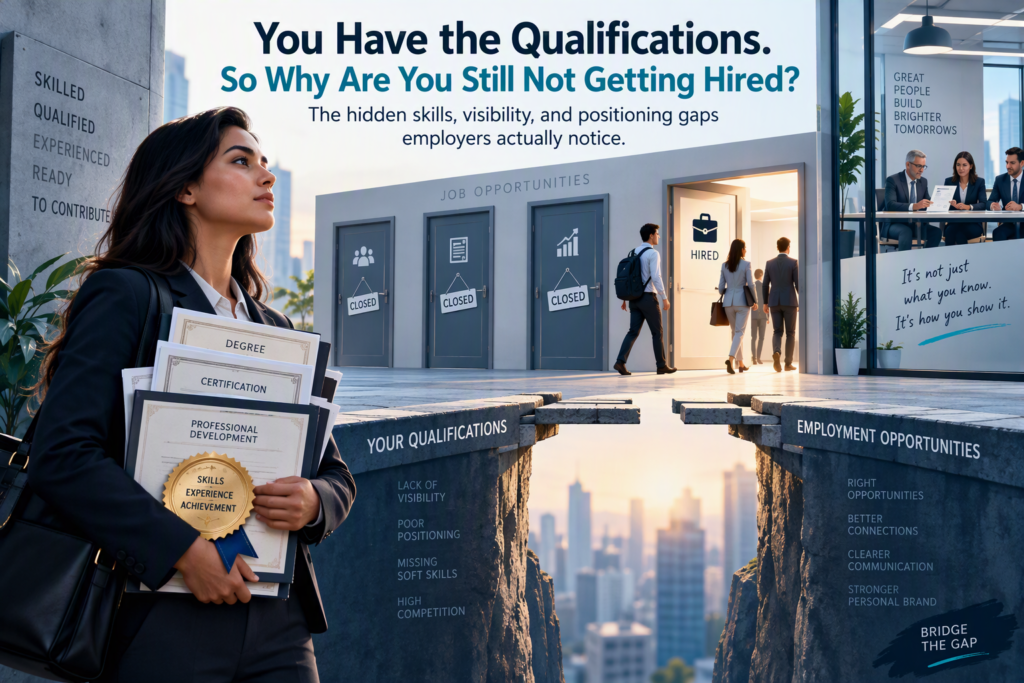
Landing one of these roles usually comes down to closing three gaps at once: technical skills, a recognised certification, and local experience employers can actually verify. That’s the exact problem the Job Ready Program was built to solve. Instead of a purely academic course, it combines practical, project-based IT training with career counselling, resume and cover letter support, interview preparation, and a remote internship you complete alongside your existing job or study. Courses start from $899, with full job-ready pathways from $4,599, and cover Business Analysis, Cloud Computing, Cyber Security, Data Analysis, Database, IT Job Ready, Project Management, Software Testing, and Web Development. You can start with a single course and upgrade to a complete program later as your goals and budget allow. If you’re not sure which IT career in Australia fits your background, browse the full course list, check the FAQs, read the blog for more career guidance, or get in touch and a career counsellor will help map out the right pathway.
Frequently Asked Questions About IT Careers in Australia
What is the highest-paying IT career in Australia in 2026?
Cloud engineering and DevOps roles currently sit at the top of the pay scale for IT careers in Australia, with senior cloud architects and DevOps engineers regularly earning $150,000–$180,000+, and specialist AI/machine learning engineers going even higher in Sydney and Melbourne.
Do I need a university degree to start an IT career in Australia?
No. A growing share of Australian employers now hire based on demonstrated skills, certifications, and a portfolio rather than a formal degree, particularly in cybersecurity, cloud, data analysis, and software testing.
Which IT certifications do Australian employers value most?
AWS and Microsoft Azure certifications for cloud roles, CompTIA Security+ and CISSP for cybersecurity, PMP for project management, and IIBA credentials for business analysis are the certifications most consistently requested in job ads.
How long does it take to become job-ready for an IT career in Australia?
With a structured program combining training, certification, and a supervised internship, most career changers and graduates can become job-ready within three to six months.
Which Australian city has the most IT job opportunities?
Sydney has the largest volume of IT job listings and the highest average pay, followed closely by Melbourne, with Brisbane, Perth, Adelaide, and Canberra all offering strong, growing markets.
Final Thoughts
Australia’s technology sector isn’t slowing down in 2026 if anything, the gap between demand and skilled supply is the widest it’s been in years, and that gap is your opportunity. Whichever of these ten IT careers in Australia matches your interests and background, the fastest path in combines the right certification with real, practical experience. Job Ready Programs runs classroom and live virtual training across Sydney, Melbourne, Brisbane, Perth, Adelaide, and Canberra. Contact us to talk through your goals and find the right course to start building your IT career in Australia today.