
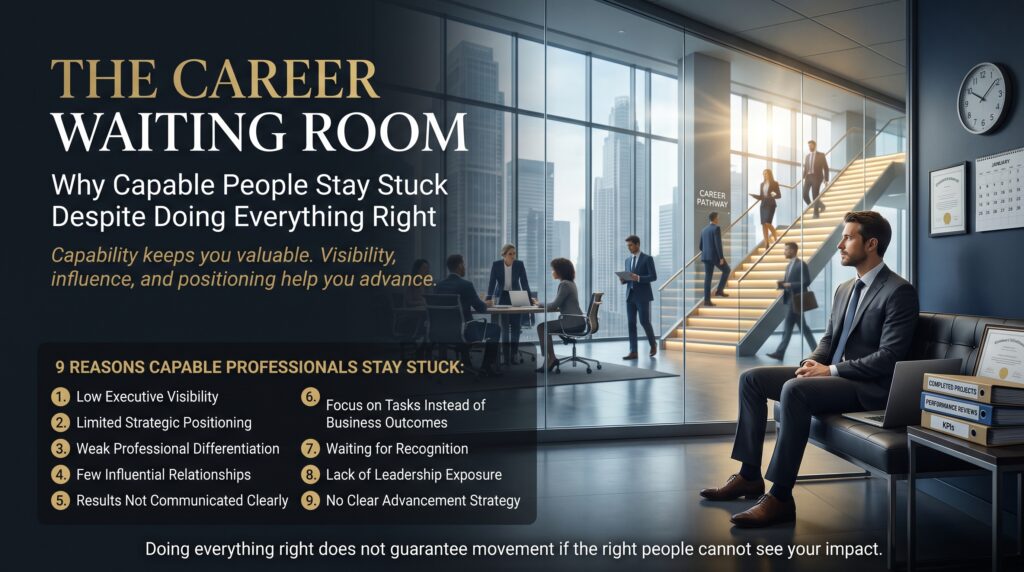



The career waiting room is the place capable people end up when they have ticked every box and still nothing moves. You finished the degree. You added the certification. Your resume has been polished three times and you apply every week. Yet the phone stays quiet, the promotion goes to someone else, and a polite voice keeps telling you to be patient.
If you feel stuck in your career, it is easy to assume the problem is you. Usually it isn’t. More often, you are following a perfectly sensible set of instructions that quietly stopped working. The rules that got your parents or older colleagues ahead, such as study hard, work hard and wait for recognition, don’t describe how hiring and promotion happen in 2026.
In this guide we’ll explain what the career waiting room really is, why smart and diligent people get trapped in it, and the practical steps that help you walk out. We’ll also look at how it plays out in Sydney, Melbourne, Brisbane, Perth, Adelaide and Canberra, and which IT pathways can shorten the wait.
What Is the Career Waiting Room?
Think of a real waiting room. You arrive on time, you fill in the form, you sit quietly, and you assume someone will call your name. Nobody is being unfair. The system simply runs on a queue, and you can sit in a queue for a very long time without anything happening.
The career waiting room works the same way. It is the stage where your preparation is complete but your progress depends on someone else noticing, choosing or approving you. You’re qualified, you’re willing and you’re waiting. The danger is that waiting feels productive. Another course, another application, another year of “just doing a good job” all feel like movement. But if none of them change how an employer sees you, you’re still in your seat.
Signs You Are in the Career Waiting Room
Being stuck in your career rarely arrives with a warning. It builds slowly. Here are the signals we hear most often from learners:
- You apply for dozens of roles and receive automated rejections or no reply at all.
- You get interviews but not offers, or you are told you were “close”.
- Feedback sounds like “great profile, but we need more local experience” or “we went with someone who was a better fit”.
- You have collected several certificates, yet your job title and pay haven’t changed.
- You have been in the same role for more than two years, doing well, with no clear next step.
- You feel busy but can’t point to anything you’ve done this quarter that makes you more hireable.
If three or more of these sound familiar, you are probably sitting in the career waiting room right now. That is useful information, because it means the fix is a change of approach, not a lack of talent.
Why Capable People Stay Stuck in the Career Waiting Room
Across years of training graduates, career changers and new arrivals to Australia, we see the same six reasons repeat. Notice that none of them are about intelligence or work ethic.
1. They follow a checklist instead of a strategy
“Get the degree, get the certificate, apply online” is a checklist. A strategy answers a sharper question: which specific role, at which kind of employer, will I be the obvious choice for, and what evidence will prove it? Without that target, effort spreads thin. You can do everything right and still be aiming at nothing.
2. They wait to be noticed
Many diligent people believe good work speaks for itself. In a busy workplace or a crowded applicant pool, it rarely speaks loudly enough. Managers promote people they can describe in one sentence. Recruiters call people they can find in a search. If your value is invisible, you stay in the career waiting room no matter how good you are.
3. Their credentials don’t connect to a next role
A certificate proves you learned something. It doesn’t automatically show how that learning solves a problem for an employer. A bridge is needed: a project, a case study or a piece of practical work that links “I studied this” to “I can do this for you”. Without the bridge, qualifications pile up beside the door instead of opening it.
4. They apply widely instead of precisely
Sending the same resume to eighty roles feels like effort. In practice it signals that you haven’t decided what you want. Targeted applications, where your headline, keywords and examples mirror the role, outperform volume almost every time. Applicant tracking systems (ATS) and tired recruiters reward clarity.
5. They miss the unwritten requirements
Job ads list what’s required. They rarely list what actually decides the outcome: familiarity with Australian workplace practice, evidence of working in a team, someone vouching for you, or a polished way of explaining your career story. This is especially true for migrants and graduates, where employers often ask for local context. The gap is real, but it can be closed with practical placements, projects and coaching.
6. They have no feedback loop
When you send applications into silence, you learn nothing. People who leave the career waiting room quickly build a loop: ask for feedback, adjust one thing, test again. Without it, you repeat the same approach and expect different results.
Doing Everything Right vs. What the Career Waiting Room Needs
Here is how the “right” actions compare with the extra step that actually moves you forward.
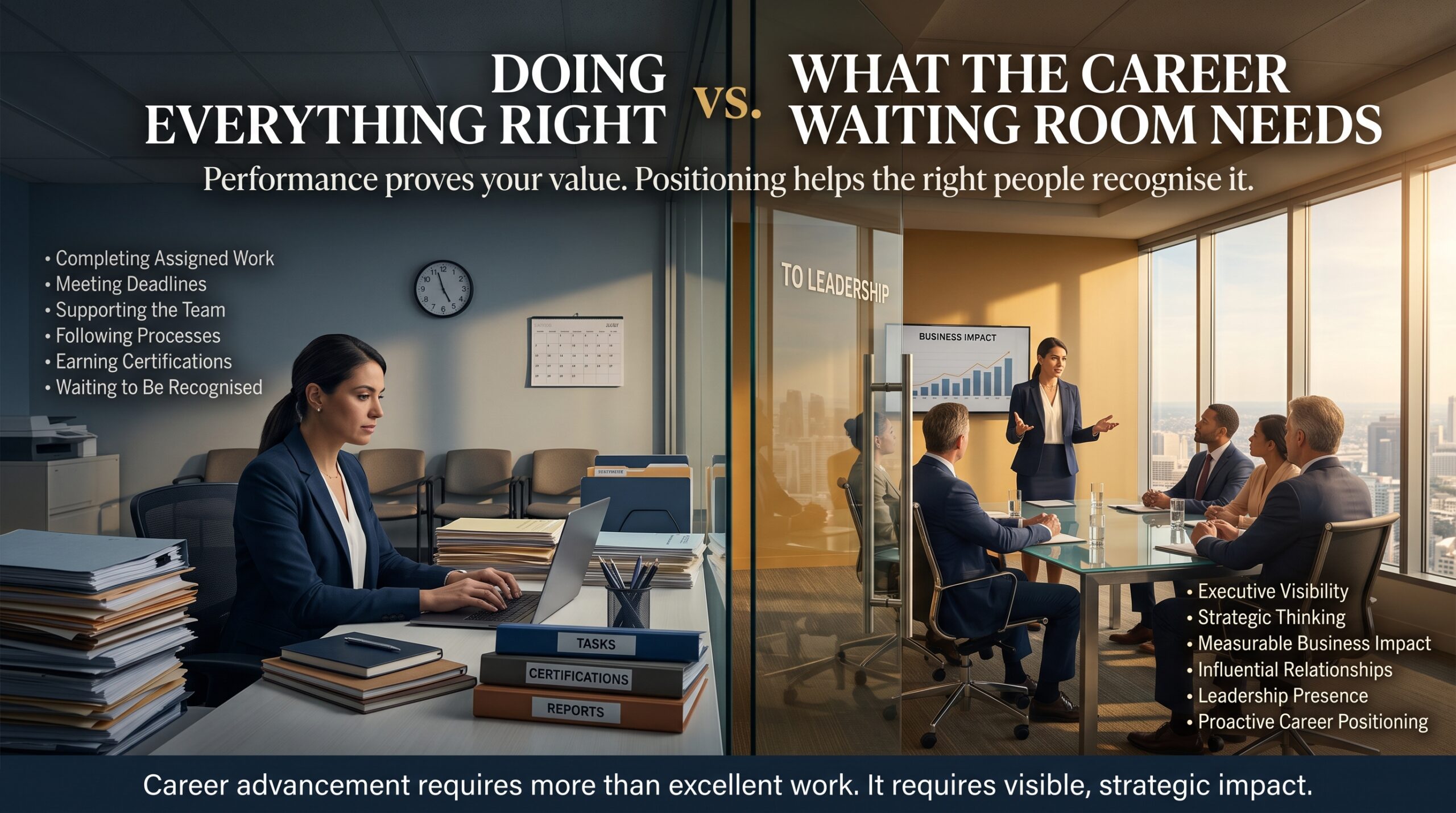
| What you did right | Why it stalls | The missing step |
| Completed a degree or certification | Hundreds of other applicants hold the same credential | Add a practical project that shows the skill in action |
| Polished your resume | It lists duties, not outcomes | Rewrite bullets with results, numbers and context |
| Applied to many jobs | Generic applications blend in | Target 10 to 15 well-matched roles with tailored keywords |
| Worked hard in your role | Nobody senses your next-level ability | Share wins, ask for stretch work, name your next goal |
| Stayed patient | The queue doesn’t move by itself | Set a 30-day action plan and review it weekly |
How Hiring Really Works in Australia
Understanding the process helps you see where you are being filtered out. Most hiring follows a predictable path, and each stage has its own career waiting room trap:
- ATS screening: software scans for role-specific keywords before a person reads a word. Mirror the exact language of the ad where it’s truthful.
- Recruiter and hiring manager review: a fast skim of your headline and top achievements. Outcome-led bullets win here.
- Interviews: many employers use behavioural questions and the STAR method (Situation, Task, Action, Result). Vague answers keep you in the queue.
- Referrals and reference checks: familiar names reduce risk. Building even a small professional network changes how finalists are compared.
To see which roles and industries are growing, browse the Australian Government’s Labour Market Insights portal. For practical resume and interview tips, SEEK Career Advice is a handy reference, and the Fair Work Ombudsman explains your rights on pay, probation and conditions as you move into a new role.
How to Leave the Career Waiting Room: 5 Practical Moves
- Choose one destination. Pick a single role title and industry for the next 90 days, such as “junior data analyst in retail” or “software tester in financial services”. Everything else you do should point there.
- Build a bridge project. Create one piece of work that shows the skill in action: a dashboard, a test plan, a requirements pack or a home lab. Write a one-page summary of the problem, your approach and the result.
- Gather real workplace evidence. Structured placements and internships matter because they give you something concrete to talk about. Our programs include a remote internship option, so you can build experience without leaving your current job.
- Make yourself findable. Update your LinkedIn headline and summary with the role and skills you want, and share one short post about your project. Recruiters search by keyword before they post ads.
- Create a feedback loop. Ask two people, such as an instructor, a recruiter or a former manager, to review your resume and explain your answers in a mock interview. Change one thing at a time and track the response.
None of this requires a new degree to leave the career waiting room. It requires deciding where you want to go and making that direction visible.
Career Waiting Room Across Australian Cities
Where you search shapes how you escape. Each city has its own employer mix and networking culture.
- Sydney: a large and competitive market with strong finance, consulting and technology employers. Standing out through specific positioning matters more than ever. See the Job Ready Program in Sydney and IT courses in Sydney.
- Melbourne: a blend of technology, education, health and startup employers. Community events and portfolio work help you get noticed. Explore the Job Ready Program in Melbourne and IT courses in Melbourne.
- Brisbane: a growing market where local connections carry real weight. Visit the Job Ready Program in Brisbane or IT training in Brisbane.
- Perth: resources, energy and the technology teams that support them. Industry context sets candidates apart. Check the Job Ready Program in Perth and IT courses in Perth.
- Adelaide: a closer-knit market where reputation travels fast and referrals count. Read about the Job Ready Program in Adelaide and IT courses in Adelaide.
- Canberra: a public sector and contractor environment that values clear documentation and reliability. See the Job Ready Program in Canberra and IT courses in Canberra.
Prefer flexibility? You can also train through live virtual classes. Browse all job ready program locations to compare options.
IT Pathways That Shorten the Wait
If your goal is a technology career, structured training can be the fastest way to build the bridge described above. Popular pathways include:
- Data analysis: turn spreadsheets and dashboards into hireable evidence. See the Data Analysis program and data analytics courses.
- Cyber security: build lab work and incident write-ups. Explore the Cyber Security program and cyber security courses.
- Business analysis: show requirements, process maps and stakeholder communication. Learn about the Business Analysis program and business analyst courses.
- Software testing: document test cases and clear bug reports. Start with the Software Testing program or software testing courses.
- Project management: present plans, risk registers and communication templates. See the Project Management program and project management certifications.
- Cloud, database and web development: show a working deployment, schema or small site. Browse Cloud Computing, Database and Web Development.
Not sure where to start? The IT Job Ready program is a good entry point, and the wider IT courses library shows how skills connect.
A 30-Day Plan to Walk Out of the Career Waiting Room
- Week 1: choose your target role and industry. Rewrite your LinkedIn headline and resume summary around it.
- Week 2: build or polish one bridge project and write a one-page summary of the result.
- Week 3: rewrite every resume bullet as an outcome. Match keywords to three real job ads in your target field.
- Week 4: message ten people with a specific, polite question, apply to well-matched roles only, and practise three STAR stories aloud.
Review what happened on day 30. If you got replies, double down. If you didn’t, change one variable and run the cycle again. That is how people leave the career waiting room: through small, repeated tests, not one big leap.
How Job Ready Programs Help You Move Forward
The Job Ready Program is built for people who have done the learning but need the bridge. It combines practical IT training with recognised certification preparation, career counselling, resume and cover letter support, and interview preparation. A remote internship option lets you gain hands-on experience in your own time, so you don’t have to leave your current job or attend a centre every day.
Programs run for students, graduates, migrants and career changers, with classroom and live virtual delivery. As listed on our site, individual courses start from $899 and complete job-ready programs from $4,599, so you can begin with one course and upgrade later. You can also explore Logitrain job ready programs for pathways and local work experience support. Results depend on your effort, but the structure takes away the guesswork about what to do next.
Frequently Asked Questions About the Career Waiting Room
Why do I feel stuck in my career even though I am qualified?
Qualifications show you met a standard, but employers choose between similar candidates using visible evidence, clear positioning and trust. If those are missing, you can feel stuck in your career despite doing everything right.
How long does it take to get out of the career waiting room?
It varies by field and market, but many people see better responses within four to eight weeks of changing their approach: a clear target, a proof project and tailored applications. Larger changes, such as switching industries, take longer.
Will another certification fix being stuck?
Rarely on its own. A certification helps most when it is paired with practical projects, workplace evidence and a clear story about the role you want next.
Can migrants and new graduates leave the career waiting room without local experience?
Yes, but it takes deliberate steps. Structured projects, remote internships, networking and coaching all help you show Australian workplace readiness before your first local role.
What is the first step I should take today?
Write down one specific role you want in the next 90 days. Every later decision, from your resume to your next course, gets easier once that target exists.
Final Thoughts: Waiting Is Not a Strategy
Capable people don’t stay in the career waiting room because they lack ability. They stay in the career waiting room because the rules they were taught reward patience over visibility. Choose a direction, build one piece of proof and put it where employers can see it. The door usually opens sooner than you expect.
Ready to move? Contact our team or call 1300 649 299 to talk through the right pathway in Sydney, Melbourne, Brisbane, Perth, Adelaide, Canberra or online.