
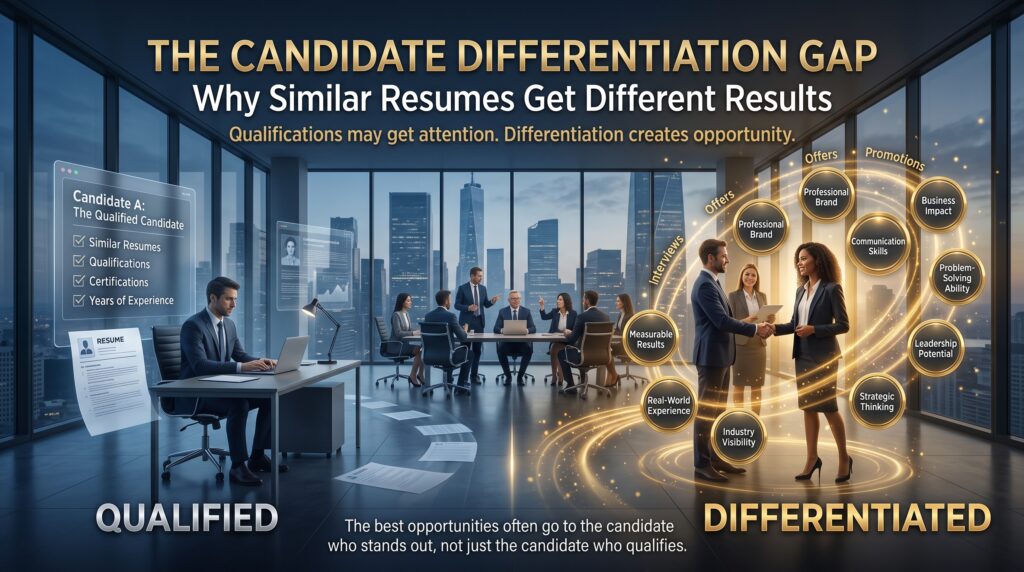
The candidate differentiation gap is the reason two people with almost identical resumes can get completely different results. Same degree, same job titles, same list of tools, yet one gets calls within a week and the other hears nothing for months. It feels unfair, and it often is a little unfair, but it isn’t random.
Most job seekers assume the problem is qualifications. They add another course, another keyword, another line to the skills section. Meanwhile, the hiring manager is reading a stack of resumes that all say roughly the same thing, and the question in their mind is simple: why this person rather than the next one? When the answer isn’t visible, the candidate differentiation gap decides the outcome.
In this guide, we’ll explain what the candidate differentiation gap is, why similar resumes perform so differently, and which seven differentiators actually move the needle. You’ll also get a practical six-step plan and a look at how structured training with career support can help you stand out in the Australian job market.
What Is the Candidate Differentiation Gap?
The candidate differentiation gap is the distance between being qualified and being visibly different from other qualified applicants. It’s what separates “meets the requirements” from “I want to speak to this person.”
It tends to show up in three ways:
- Resumes that list duties and tools in the same generic language as everyone else’s.
- Claims such as “strong communicator” or “quick learner” with nothing to back them up.
- Skills that exist in real life but aren’t shown through projects, results or clear examples.
The good news is that the candidate differentiation gap isn’t about talent. It’s about evidence, clarity and presentation, which are all skills you can improve.
Why Similar Resumes Get Different Results
Economists use the idea of signalling) to explain how people communicate hidden qualities, such as ability or reliability, to others who can’t verify them directly. A resume is a bundle of signals. When every candidate sends the same signals, employers look for stronger ones.
Several practical factors widen the candidate differentiation gap:
- Recruiters often review many applications in a short time, so specific, relevant details win attention.
- Hiring is a risk decision. Clear evidence of past results makes a candidate feel like a safer bet.
- Fit with the role. A resume tailored to the job ad reads as intentional. A generic one reads as mass-produced.
- Proof over promises. A short project or measurable result is more convincing than a list of adjectives.
Think of it this way: two candidates may be equally capable, but the one who makes their capability easier to see usually gets the call.
Seven Differentiators That Close the Candidate Differentiation Gap
These seven areas are where similar candidates most often pull apart.
1. Outcomes Instead of Duties
“Responsible for customer tickets” describes a job. “Resolved tickets quickly and helped reduce repeat issues by documenting common fixes” describes a contribution. Whenever you can, state what changed because you were there, and use numbers only when they’re accurate.
2. A Clear Target Role and Headline
A resume that tries to suit every job usually suits none. Pick a direction, such as data analyst, cyber security support or business analyst, and make your headline and summary say so plainly.
3. Visible Proof: Projects and Portfolios
Documented projects shrink the candidate differentiation gap faster than almost anything else. A dashboard, a test plan, a small cloud lab or a process map shows how you think and gives interviewers something specific to discuss.
4. Certifications That Match the Job
A relevant, recognised certification tells an employer you’ve met a clear standard. The key word is relevant. Choose credentials that align with the roles you’re targeting, and pair them with practical examples.
5. Local Context and Australian Work Experience
Graduates, migrants and career changers often face the question of local experience. Structured placements, internships and projects that reflect Australian workplace practice can help answer it before it’s asked.
6. Tailoring to the Job Ad and Selection Criteria
Mirror the language of the advertisement where it honestly applies to you. Address selection criteria directly, with a short example for each. Tailoring is one of the simplest ways to narrow the candidate differentiation gap, and it’s one of the least used.
7. Communication: Cover Letters, Follow-Ups and Interview Stories
A concise cover letter that links your skills to the company’s needs, a polite follow-up and a handful of well-prepared stories can lift a candidate above equally qualified rivals. Confidence is easier when you’ve prepared specific examples.

Here is how a typical resume line changes when it’s built to differentiate:
| Area | Typical similar-resume line | Differentiated version |
| Experience bullet | Responsible for customer support tickets | Resolved customer tickets and documented common fixes to reduce repeat issues |
| Headline | Motivated IT professional seeking opportunities | Data analyst with SQL and Power BI projects, targeting reporting roles |
| Skills | Excel, SQL, communication, teamwork | SQL and Excel used in a documented sales-reporting project (link included) |
| Certification | Listed with no context | Listed with a one-line example of how it was applied |
| Cover letter | Not included | Short, role-specific letter explaining fit and one relevant result |
A Simple Example: Two Candidates, One Job
Imagine two applicants for the same entry-level data role. This is an illustration, not a statistic, but it reflects a pattern many hiring managers will recognise.
Both hold similar qualifications and list the same tools. The first sends a general resume with duty-based bullet points and no cover letter. The second sends a resume with a clear headline, two documented projects, a relevant certification and a short cover letter that explains why the role suits them.
Nobody would argue the second candidate is a different person. They simply closed the candidate differentiation gap for the reader. When the shortlist is being drawn, that difference does the work.
How to Close the Candidate Differentiation Gap: A Six-Step Plan
- Audit your resume against three job ads. Highlight the skills and results that appear in every ad. If they’re missing or buried in your resume, move them up.
- Rewrite duties as outcomes. Convert each bullet into what you did, how you did it and what improved.
- Build two small proof pieces. Choose projects linked to your target role and document them clearly with the problem, the approach and the result.
- Choose one relevant certification. Match it to the role, not to what’s popular this month.
- Add a tailored cover letter. Keep it short and specific to the company and role.
- Practise your stories. Prepare three examples for common questions, using a clear situation, action and result structure.
Stay honest throughout. The aim of closing the candidate differentiation gap is to make your real strengths visible, not to invent new ones. Employers verify details, and consistency builds trust.
Common Mistakes That Widen the Candidate Differentiation Gap
- Sending one generic resume to every employer.
- Listing every tool you’ve touched instead of the ones that matter for the role.
- Using vague adjectives with no supporting example.
- Collecting certificates without applying them in a project.
- Skipping the cover letter or reusing it without editing.
- Ignoring the market. Jobs and Skills Australia publishes labour market information that can help you understand which skills are in demand, and SEEK career advice offers general application guidance.
How Job Ready Programs Help Close the Candidate Differentiation Gap
Standing out requires skills, proof and confidence, and that’s where Job Ready Programs focus. The programs combine practical IT training, recognised certification preparation, career counselling, resume and cover letter support and interview preparation, so you build both the substance and the story.
A remote internship delivered through Logitrain lets learners complete project work in their own time while keeping their current job, which creates real examples for a resume. According to the site, individual courses start from $899 and complete job-ready programs start from $4,599, so you can begin with a single course and upgrade later. You can also read the Job Ready Program FAQs or explore the Logitrain job ready programs.
Choose the pathway closest to your target role:
| Target role area | Pathway | Page |
| Business analyst | Business Analysis | Business Analysis program |
| Cloud support or engineer | Cloud Computing | Cloud Computing program |
| Security analyst | Cyber Security | Cyber Security program |
| Data analyst | Data Analysis | Data Analysis program |
| Database roles | Database | Database program |
| General IT and support | IT Job Ready | IT Job Ready program |
| Project coordinator or manager | Project Management | Project Management program |
| Software tester | Software Testing | Software Testing program |
| Web developer | Web Development | Web Development program |
More from our training network: data analytics courses, business analyst course, software testing course and IT courses.
Job Ready Programs in Sydney, Melbourne, Brisbane, Perth, Adelaide and Canberra
The candidate differentiation gap exists in every Australian job market. A Sydney recruiter facing hundreds of similar applications and a Canberra hiring manager comparing near-identical resumes are asking the same question. Training and career support are available through classroom, live online and in-house options depending on your location.
| City | Who often benefits | Delivery | Location page |
| Sydney | Graduates and career changers in tech and finance | Classroom (Surry Hills) or live online | Job Ready Program Sydney |
| Melbourne | Career changers and IT beginners | Classroom (West Melbourne) or live online | Job Ready Program Melbourne |
| Brisbane | Graduates and business professionals | Classroom (Brisbane City) or live online | Job Ready Program Brisbane |
| Perth | Professionals moving into tech and analyst roles | Live online or in-house | Job Ready Program Perth |
| Adelaide | Graduates and public-sector job seekers | Live online or in-house | Job Ready Program Adelaide |
| Canberra | Government contractors and career changers | Live online or in-house | Job Ready Program Canberra |
Compare all options on the Job Ready Program locations page or contact the team to talk through the best starting point.
Frequently Asked Questions About the Candidate Differentiation Gap
What is the candidate differentiation gap?
It’s the difference between being qualified for a role and being clearly distinguishable from other qualified applicants. It explains why similar resumes often get different results.
Why do similar resumes get different results?
Because employers look for stronger signals than a standard list of duties and tools. Clear outcomes, relevant proof, tailored applications and good communication make one candidate easier to choose.
How can I stand out with no experience?
Build documented projects, earn a relevant certification, and add practical or internship experience where possible. Evidence of real work can offset a short employment history.
Do certifications really help?
Relevant certifications help signal that you’ve met a recognised standard. They work best when paired with practical examples that show you can apply what you learned.
Can career counselling improve my results?
Yes. Counselling helps you refine your resume, respond to selection criteria, tailor cover letters and practise interviews, all of which narrow the gap between you and other candidates.
Can I study a Job Ready Program online?
Yes. Live online options are available alongside classroom delivery in major cities, with weekday, weeknight and weekend schedules.
Make Your Strengths Impossible to Miss
The candidate differentiation gap is frustrating because it hides in plain sight. Two resumes can look equal on paper, yet one tells a clearer, more convincing story. The fix isn’t louder claims. It’s better evidence, sharper targeting and consistent communication.
If you’re ready to build that evidence, explore the Job Ready Programs, pick a nearby location, or get in touch to plan your next step.