


ATS resume screening is the first hurdle almost every Australian job applicant faces often before a human ever opens their resume. If you’ve applied to dozens of IT, business, or project management roles and heard nothing back, the problem may not be your experience. It may be that an Applicant Tracking System (ATS) filtered you out in seconds. This guide breaks down exactly how recruiters use ATS software to filter resumes, which platforms Australian employers rely on, and most importantly how to format and write your resume so it gets through the filter and lands in front of a real recruiter.
What Is ATS Resume Screening and Why Do Recruiters Use It?
An Applicant Tracking System (ATS) is software that collects, sorts, scans and ranks job applications before a recruiter looks at them. For a single mid-level IT role advertised on SEEK or LinkedIn, an Australian employer can receive 150–300 applications within days. Reviewing every resume manually isn’t realistic, so recruiters lean on ATS resume screening to shortlist the top 5–10% automatically.
ATS software scores each resume against the job description using keyword matching, required qualifications, years of experience, location, and formatting. Resumes that don’t match closely enough are ranked low or auto-rejected regardless of how qualified the candidate actually is. This is why understanding ATS resume screening matters as much as the skills on your resume.
How Recruiters Use ATS Software to Filter Resumes
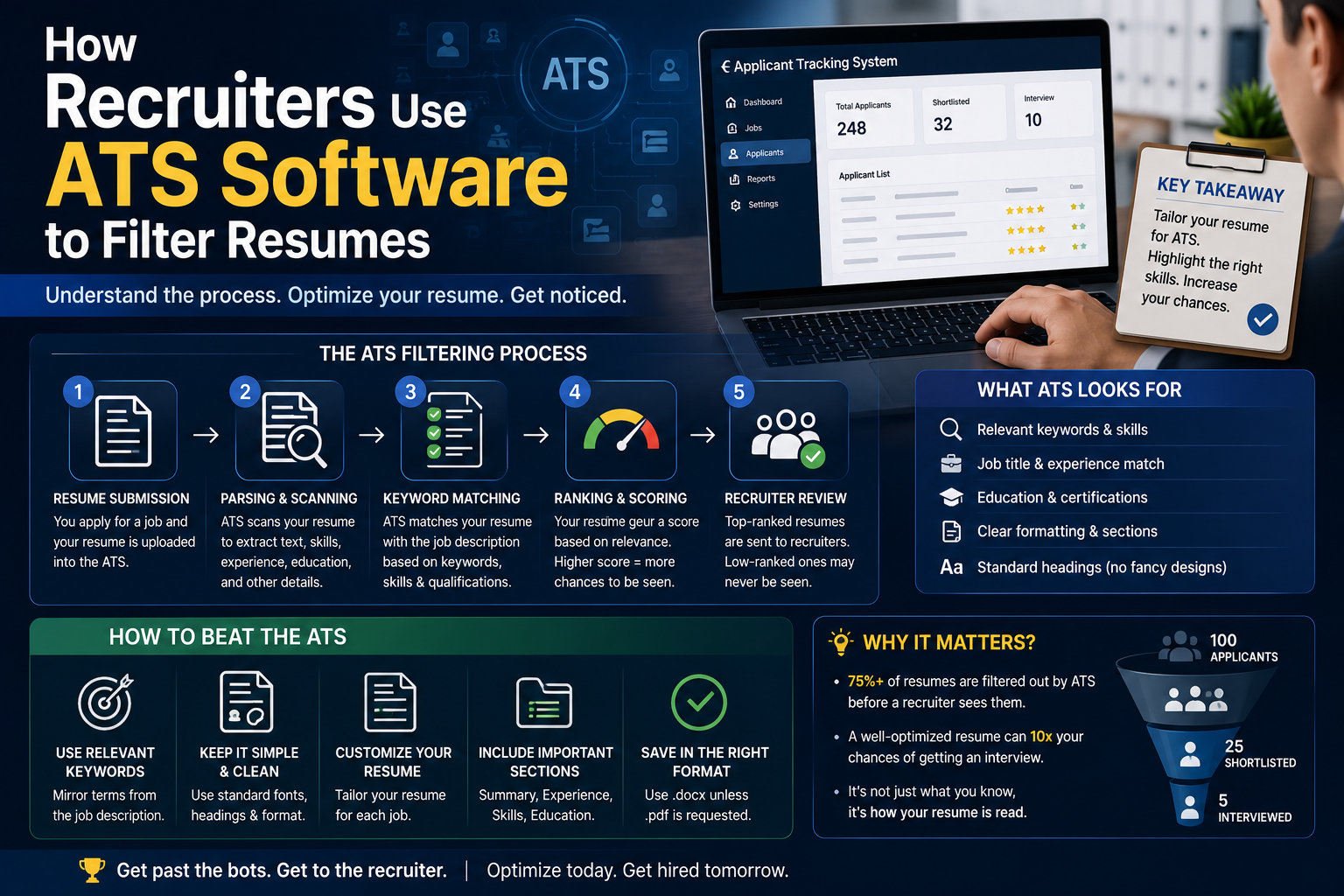
Recruiters don’t sit and read every resume line by line at the first stage. Instead, the ATS does the heavy lifting through a few consistent mechanisms:
1. Keyword and Skills Matching
The ATS scans your resume for exact keywords pulled from the job ad job titles, certifications (e.g. “PRINCE2”, “AZ-900”, “Scrum Master”), tools (e.g. “Power BI”, “SQL”, “JIRA”), and required qualifications. Resumes missing these exact terms score lower, even if you have equivalent experience described differently.
2. Resume Parsing and Formatting Checks
The ATS converts your resume into plain text to extract your name, contact details, work history and education into its database. Complex formatting tables, text boxes, columns, headers/footers, graphics, or unusual fonts can break this parsing step, scrambling or dropping your information entirely.
3. Ranking and Scoring
Once parsed, candidates are ranked by match percentage. Recruiters typically only open resumes above a set threshold (often 70–80% match), meaning a strong candidate with a poorly optimised resume may never be seen by a human at all.
4. Knockout Questions and Filters
Many ATS platforms present screening questions before you can even submit right to work in Australia, years of experience, salary expectations, willingness to relocate. Answering these inconsistently with your resume content can trigger an automatic rejection.
Common ATS Software Platforms Used by Australian Employers
Understanding the landscape helps you tailor your approach. Australian employers and recruitment agencies commonly use:
- Workday widely used by large enterprises and government agencies
- Taleo (Oracle) common in banking, telco and large corporates
- SmartRecruiters and Greenhouse popular with tech companies and scale-ups
- SEEK Talent Search and SEEK’s employer dashboard used by SMEs recruiting directly
- LinkedIn Recruiter used alongside a primary ATS for sourcing and initial filtering
- PageUp and iCIMS common across Australian universities, health and public sector roles
Trusted sources: For candidates who want to test their own resume’s ATS match score, Jobscan’s ATS resume checker is a widely used tool, and SEEK’s Employer Hub outlines how Australian employers commonly screen and rank applications on their platform.
Signs Your Resume Is Being Rejected by ATS Resume Screening
- You apply to roles you’re clearly qualified for and get zero responses
- You never receive an automated “application received” follow-up beyond the initial confirmation
- Your resume uses graphics, columns, or a creative template downloaded from a design site
- You save your resume as an image-based PDF or a scanned file
- Your resume lists skills under a “Skills” cloud/graphic instead of as plain text
How to Beat ATS Software: A Practical Checklist
You can’t out-trick an ATS, but you can format and write a resume that parses cleanly and matches strongly. Here’s what actually works:
| Do This | Why It Beats ATS Resume Screening |
| Use a simple, single-column layout | Tables and columns confuse ATS parsers and can scramble your work history |
| Save as .docx or a text-based PDF | Image-based PDFs and scanned files often can’t be read at all |
| Use standard section headings | “Work Experience”, “Education”, “Skills” — not creative labels the ATS won’t recognise |
| Mirror exact keywords from the job ad | Match certification names, tools and job titles word-for-word where genuinely true |
| Spell out acronyms once | e.g. “Certified ScrumMaster (CSM)” so both the acronym and full term are captured |
| Avoid headers, footers and text boxes | Contact details placed here are frequently missed by parsers |
| Use standard fonts (Arial, Calibri, Times New Roman) | Decorative fonts can render as broken characters after parsing |
| List skills as plain bullet text | Skill clouds, graphics or icons are often invisible to the ATS |
Building an ATS-Friendly Resume for Australian IT and Business Roles
Beyond formatting, content strategy matters. Tailor your resume for every application by pulling 8–12 keywords directly from the job description and weaving them naturally into your summary, experience bullets and skills section. For candidates entering IT, project management, business analysis or data roles without prior local experience, this is especially important — recruiters and their ATS software have no context to “read between the lines,” so your resume needs to state your qualifications explicitly and clearly.
This is exactly the gap Job Ready Programs are designed to close. Structured, industry-aligned training plus a resume built around real, recognised certifications gives your application the exact keyword matches Australian ATS software is scanning for.
ATS Resume Screening Across Australian Job Markets
ATS adoption and the volume of applications per role varies by city, which affects how competitive keyword matching needs to be:
- Sydney — Highest application volume for IT and business roles; strong keyword matching is essential given heavy competition
- Melbourne — Large enterprise and government use of Workday/PageUp; formatting compliance matters as much as keywords
- Brisbane — Growing tech and infrastructure sector; recruiters increasingly rely on SEEK Talent Search filters
- Perth — Resources and IT support roles; ATS filters often weight certifications heavily
- Adelaide — Defence, health and government roles frequently use PageUp/iCIMS with strict knockout questions
- Canberra — Public sector recruitment leans heavily on ATS-driven compliance and mandatory selection criteria matching
How Job Ready Programs Help You Beat ATS Resume Screening
A Job Ready Program pairs recognised certification training with practical, portfolio-ready projects giving you both the credentials and the language recruiters’ ATS software is actively scanning for. Instead of guessing which keywords matter, you’re trained in the exact frameworks, tools and terminology used in real Australian job ads.
Explore Job Ready Programs for your target field: Job Ready Programs Australia, Data Analytics Courses, Business Analyst Course, Cybersecurity Certifications, Software Testing Course, Power BI Course, Scrum Master Certification, Project Management Certifications, AZ-900 Microsite, CCNA Certification and the full course catalogue at Logitrain.
Frequently Asked Questions About ATS Resume Screening
Does every Australian employer use an ATS?
Most mid-size to large employers do, along with recruitment agencies and government departments. Small businesses hiring directly may review resumes manually, but ATS resume screening is now the default for most advertised roles on SEEK and LinkedIn.
Will a PDF resume pass through ATS software?
A text-based PDF (created from Word, not scanned) generally parses fine. Avoid image-based or design-heavy PDFs, as these often fail to parse correctly.
Should I use the exact same resume for every application?
No. Tailor keywords to each job ad. A resume optimised for a Business Analyst role won’t score well against a Data Analyst ATS filter, even if the underlying skills overlap.
Can certifications improve my ATS resume screening score?
Yes. Recognised certifications (PRINCE2, PMP, AZ-900, CCNA, Scrum Master, CompTIA) are common exact-match keywords ATS software is configured to look for, particularly in government and enterprise job ads.
Final Thoughts on Beating ATS Resume Screening
ATS resume screening isn’t going away if anything, more Australian employers are adopting it every year. The candidates who get shortlisted aren’t necessarily the most qualified; they’re the ones whose resumes are formatted cleanly and written in the language the ATS is trained to recognise. Combine a clean, keyword-matched resume with recognised, job-ready certifications, and you significantly improve your odds of getting past the filter and in front of a real recruiter.