

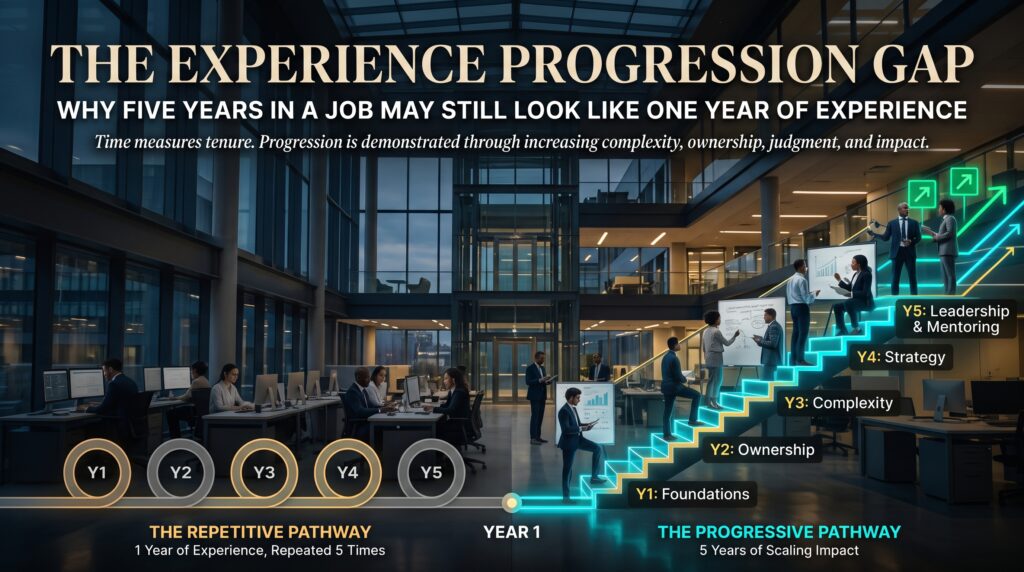
The experience progression gap is the difference between how long you have worked and how much you have grown while doing it. You can hold the same job for five years, be reliable, well liked and busy every day, and still have a resume that reads like one year of experience repeated five times. Employers do not count years. They read for growth, and when growth is not visible, tenure counts for much less than people expect.
This is one of the most frustrating realities in the Australian job market. Someone with half a decade in a role applies for a step up and loses to a candidate with two years who has taken on more complex work, learned newer tools and can describe real outcomes. If that sounds familiar, you are not alone, and it is fixable. This guide explains why the experience progression gap happens, how hiring managers interpret it, and what you can do to close it. If you are ready to build the missing skills, our Job Ready Programs are designed for exactly this kind of move.
What Is the Experience Progression Gap?
The experience progression gap appears when your responsibilities, skills and results stay roughly the same year after year. The calendar moves forward, but the work does not get harder, broader or more valuable. On paper, that looks like repetition rather than progression.
It is not a character flaw and it is not laziness. Many capable people end up in roles that run on a steady routine, with no obvious promotion path and no time set aside for learning. The experience progression gap simply describes the result: lots of time, limited visible growth.
Why Five Years in a Job Can Look Like One Year of Experience
Recruiters and hiring managers scan resumes quickly. They are looking for evidence that you have tackled increasing complexity. Here is the difference between what you may feel you have and what the page shows.
| Factor | What it feels like from the inside | What an employer sees |
| Time in role | Five years of reliable service | One role, one level, no visible step up |
| Responsibilities | Busy and always delivering | The same duties listed for each year |
| Skills | Deep knowledge of one system | Narrow toolset, nothing recent |
| Results | Customers and managers are happy | No measurable outcomes on the resume |
| Learning | Learned on the job | No certifications, courses or new technologies listed |
| Leadership | Informally helps new starters | No mentoring, ownership or project work recorded |
The key insight is that the experience progression gap often exists on the resume before it exists in your career. Many people have grown more than they have documented. The first job is to find that hidden growth. The second is to build more of it on purpose.
How Employers Actually Read Experience
Hiring managers rarely add up years. They ask a quieter set of questions as they read:
- Scope: Did the size or importance of your work increase over time?
- Complexity: Are you handling harder problems than you did at the start?
- Ownership: Do you run things, or only assist with them?
- Outcomes: Can you show what changed because of your work?
- Currency: Are your tools and methods up to date?
- Trajectory: Does the story point upward?
Guidance from the Australian Government’s Your Career website and from SEEK Career Advice consistently encourages job seekers to show achievements and skills rather than simply list duties, which is exactly the habit that closes the experience progression gap.
Common Causes of the Experience Progression Gap
1. The role plateaued and nobody noticed
Some jobs reach their ceiling within the first year. After that, the work repeats. Without a promotion path or stretch assignment, the experience progression gap widens quietly.
2. You stayed with one tool or process
Deep knowledge of a single system is valuable inside your company but can look narrow outside it. Employers hiring for the next level often want exposure to current, widely used platforms.
3. Achievements were never written down
Most people forget what they accomplished in year two by the time they update their resume in year five. Without a record, the resume defaults to a list of duties.
4. Learning stopped at the job
If your only learning is on the job, your skills grow at the pace of your employer’s needs. Formal training and certifications show you are building capability on your own initiative.
5. Local experience is hard to prove
Migrants and career changers often carry years of valuable work from overseas or another field but struggle to translate it for Australian employers. The experience is real, yet the progression is hard to see in unfamiliar job titles and tools.
Signs You May Have an Experience Progression Gap
- Your resume bullet points for year one and year five are nearly identical.
- You have not learned a new tool, method or certification in the last two years.
- You apply for the next level and keep hearing you need “more experience”.
- Colleagues with fewer years are being promoted or hired into senior roles.
- You struggle to describe a single project you led from start to finish.
- You cannot name a measurable result you are proud of.
How to Close the Experience Progression Gap
Closing the experience progression gap is a mix of uncovering what you have already done and building what is missing. These steps work whether you stay with your employer or move on.
- Audit your last five years. List every project, system, process change and problem you solved, however small. Add who it helped and what improved.
- Show progression, not duties. Rewrite each role in order of growth: what you started with, what you took over, what you improved.
- Ask for stretch work. Volunteer for a project, a new tool or a handover. Even one cross-team task adds scope you can describe.
- Upskill with recognised certifications. They prove current knowledge and give an employer a clear signal that you have moved forward.
- Build practical evidence. Projects, simulations and internships replace “I have done this” with “here is the work”.
- Find a mentor or sponsor. Someone senior can point you to opportunities and vouch for your readiness.
- Get career counselling. An outside view helps you choose the right next role and present your story clearly.
Resume language that shows progression
Small changes in wording make growth visible. These examples show how to move from duties to progression. Use your own real details and results.
| Duty-based line | Progression-based line |
| Handled customer support tickets | Resolved escalated support tickets and wrote troubleshooting guides now used by the wider team |
| Responsible for monthly reports | Redesigned the monthly reporting process, reducing manual work and giving managers clearer insights |
| Helped with system upgrades | Led testing for a system upgrade and coordinated fixes with developers before release |
| Worked in a team of five | Trained two new starters and became the go-to person for a key process |
The Experience Progression Gap for Career Changers and Migrants
If you are changing careers or building a local career in Australia, the experience progression gap can feel even larger. Your earlier years may be strong, but they may not map neatly to local job titles, tools or expectations. Employers also tend to value recent, relevant experience.
The solution is to translate and top up. Translate your past work into the language of your target role, and top up the gaps with practical, locally recognised training. Our IT Job Ready program combines hands-on skills, resume support and career counselling for graduates, migrants and career changers who need a faster route to credible, current experience.
Closing the Gap With Practical Training and Internships
Training works best when it produces evidence. A certification shows baseline knowledge. A project or internship shows you can apply it. Together they create a visible step forward, which is the opposite of the experience progression gap.
Our program includes a remote internship option, so you can practise delivering work without leaving your current job. You can see how the pathway fits together on the Logitrain IT job program page. No program can promise a particular job outcome, but structured training, real project work and career support give you far stronger material to put in front of employers.
The Experience Progression Gap Across Australian Cities
Employers in different cities weigh experience differently. Here is what you may notice, with links to the local program page for each city.
| City | What employers often look for | Local program page |
| Sydney | Competitive finance, consulting and technology roles that reward current tools and measurable outcomes | Job Ready Program Sydney |
| Melbourne | Enterprise IT, education and health teams that value certifications and a clear growth story | Job Ready Program Melbourne |
| Brisbane | Government, infrastructure and service-sector roles that look for dependable, upskilled candidates | Job Ready Program Brisbane |
| Perth | Resources and engineering-driven technology roles that value practical, applied skills | Job Ready Program Perth |
| Adelaide | Health, defence-related and public-sector roles with structured selection criteria | Job Ready Program Adelaide |
| Canberra | Federal agencies and contractors that assess experience against detailed criteria | Job Ready Program Canberra |
For data on which occupations and skills are in demand, Jobs and Skills Australia publishes labour market research that can help you choose where to build experience next.
Choose a Pathway to Build Visible Progression
Pick a direction that matches the role you want, then build skills and evidence in that field:
- Business Analysis: requirements, stakeholder and process skills for career changers and graduates.
- Data Analysis: reporting and business intelligence skills with clear, measurable outputs.
- Cyber Security: practical security skills and certification preparation.
- Cloud Computing: current cloud fundamentals and cost-aware practices.
- Project Management: planning and delivery skills that show ownership.
- Software Testing: test design, defect tracking and quality practices.
- Web Development and Database: core build and data skills.
Our courses start from $899, and complete job-ready programs start from $4,599, so you can start with one course and expand later. You can also explore the wider network, including IT courses, data analytics courses and business analyst courses, or compare options on Logitrain.
Mistakes That Keep the Experience Progression Gap Open
- Waiting for your employer to decide your next step.
- Listing duties on your resume instead of results and growth.
- Assuming years of service will speak for themselves.
- Learning only what your current job requires.
- Applying for the next level without any new evidence to back it up.
- Not keeping a running record of achievements as they happen.
Frequently Asked Questions About the Experience Progression Gap
What is the experience progression gap?
It is the difference between the number of years you have worked and the amount of visible growth in scope, skills and results over that time. A long tenure with little change can read like a much shorter career.
Why do employers ignore my years of experience?
They do not ignore them, but they weigh growth more heavily than time. If your resume shows the same duties year after year, a candidate with fewer years and more varied achievements may look stronger.
How do I show career progression if my job title never changed?
Focus on increasing responsibility. Describe new projects, tools, mentoring, process improvements and results you owned over time, and show them in order so the growth is clear.
Can a certification help close the experience progression gap?
Yes. A recognised certification shows current knowledge and initiative. It works best when paired with practical projects or an internship that show you can apply the skills.
Can a job ready program help if I already have years of experience?
It can, especially if you are changing fields, moving into IT or need current, locally relevant skills and evidence. Check the program page for current inclusions, as details vary by pathway.
You can find more answers on our FAQs page or read more career guides on the blog.
Final Thoughts: Make Your Years Count
Five years should not read like one year repeated. The experience progression gap is a visibility and growth problem, not a talent problem, and both halves can be solved. Document what you have done, stretch into harder work, learn something current and present the story as a climb rather than a loop.
Ready to turn years of work into visible progression? Learn about us, browse the Job Ready Programs, or talk to a career advisor on 1300 649 299.